20-Foot vs. 40-Foot Shipping Container: Which Size Do You Need?
Choosing the wrong container size is one of the most common, and most avoidable, mistakes customers make. Rent something too small and you’re back on the phone in two weeks. Go too big and you’re paying for space you don’t need.
The good news: the decision is simpler than it seems once you know what to compare. Here’s everything you need to know about 20-foot and 40-foot shipping containers before you commit.
The Basic Dimensions
Both sizes share the same width and height — it’s the length that changes everything. You can browse all available sizes and units here.

20-Foot Container40-Foot Container
Exterior Length 20 ft 40 ft
Exterior Width 8ft 8ft
Standard Height 8’6″ 8’6″ High Cube
Height 9’6″ 9’6″
Interior Length~19’4″~39’5″
Interior Width~7’8″~7’8″
Interior Height (Std)~7’10″~7’10″Approx.
Interior Sq. Ft.~150 sq ft~300 sq ft
The 40-foot unit is almost exactly double the floor space. But “double the space” doesn’talways mean it’s the right callasdelivery, placement, and your specific use case all factorin.
When a 20-Foot Container Is the Right Choice
Your site has limited space
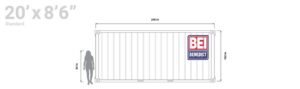
A 20-foot container needs roughly 25–30 feet of clearance for delivery and door swing. Intight urban lots,residential driveways, or cramped job sites, a 20-footer is often the onlypractical option.
You need moderate storage
For a homeowner storing furniture during a renovation, a small business managing seasonalinventory, or a contractor keeping tools and materials secure on a job site, a 20-footcontainer hits the sweet spot. It’s large enough to hold a meaningful amount of material butmanageable enough to place almost anywhere.
You want door access on both ends
20-foot containers are available with doors at one endorboth ends. Double-door accessmakes it significantly easier to organize contents and retrieve items from the back withoutmoving everything in front—a big advantage for active, frequently accessed storage.
You’re watching your budget
A 20-foot unit rents and sells for less than a 40-foot unit. If your storage volume doesn’trequire the extra length, the 20-foot container is simply the more cost-efficient choice.
When a 40-Foot Container Is the Right Choice
You have a high volume of goodsor equipment
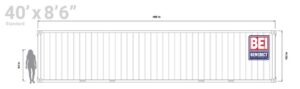
Construction crews storing large equipment, lumber, or bulk materials. Retailers managingsignificant inventory. Businesses consolidating items from multiple locations. When thevolume is there, the 40-footer earns its footprint.
You’re setting up a worksite office or combo unit
40-foot containers are the go-to for ground-level offices either as an all-office configurationor a combo unit that splits the space between an office area and storage. If you need afunctional workspaceandsecure storage in a single unit, the 40-footer is the only size thatmakes that possible.
You have a large, accessible site
Long, open properties(farms, industrial yards, large commercial lots)can accommodate a40-foot unit with ease. If space isn’t a constraint, the additional capacity is worth it.
You’re planning a custom build
If you’re thinking about converting your container into a retail space, food & beveragestand, or any other customized structure, the 40-foot unit gives you far more room to workwith. More square footage means more design flexibility, better customer flow, and room forequipment. (Our sibling companyUNCONTAINEDspecializes in exactly this kind of build.)

What About the High Cube Option?
Both 20-foot and 40-foot containers are available in a standard height (8’6″) and a highcube option (9’6″). That extra foot of interior height makes a noticeabledifference in a fewscenarios:
- Worksite offices:A standard-height container feels more cramped for full-timeoccupancy. The high cube is more comfortable for people working inside.
- Tall equipment or racking:If you’re storing items that don’t fit in a standardcontainer but would in a taller one, the high cube solves the problem withoutrequiring a larger footprint.
- Custom builds:More ceiling height opens up more design possibilitiesincludingbetter lighting, loft-style layouts, or simply a less industrial feel.
BEI offers high cube options in both 40-foot and 45-foot lengths.
| Use Case | Recommended Size |
|---|---|
| Home renovation overflow storage | 20 ft |
| Small business seasonal inventory | 20 ft |
| Construction site tools & materials | 20 ft or 40 ft depending on volume |
| Large equipment or bulk materials | 40 ft |
| Worksite office (all office) | 40 ft |
| Worksite office + storage combo | 40 ft |
| Retail or custom build | 40 ft |
| Tight urban or residential site | 20 ft |
| Farm, industrial yard, open lot | 40 ft |
Still Not Sure? Here’s What We Recommend

When in doubt, customers often go bigger and regret the delivery logistics or go smaller andrun out of room within a month. The best way to get it right is to talkthrough your specificsituation with someone who knows containers.
BEI has been matching customers with the right units for over 60 years. We serve theCincinnati,Dayton,Columbus, andIndianapolisregions and can typically deliver fast onceyou know what you need.
Get a Quote Today
Frequently Asked Questions
Can I get a 20-foot container with doors on both ends?
Yes. BEI offers 20-footcontainers with doors at one end or both ends. Double-door access is a popular option forcustomers who need to organize contents and access items from either side.
What’s the difference between a standard and high cube container?
Standardcontainers are 8’6″ tall on the exterior (roughly 7’10” interior height). High cube containersare 9’6″ tall, giving you an extrafoot of usable interior height. BEI offers high cube optionsin 40-foot and 45-foot lengths.
Do you offer sizes other than 20 ft and 40 ft?
Yes. BEI also carries 10-foot, 40-foothigh cube, and 45-foot high cube containers. The right size depends on your specific storageor workspace needs.
Is a 20-foot container big enough for a home renovation?
For most residentialprojectslikeclearing out a garage, storing furniture during a remodel, or managing a homeaddition,a 20-foot container provides plenty of space. If you’re clearing out a very largehome or need to store large pieces of furniture alongside other belongings, a 40-footergives you breathing room.
Can I rent a container without a long-term contract?
Yes. BEI offers short-termrentals with no long-term contract required. Reach out and we’ll match you to the right unitand rental terms for your timeline.
What if I need a container customized into an office or workspace?
Our siblingcompany UNCONTAINED handles full interior customization from basic ground-level officepackages to fully custom builds.Learn more about ground level office options here.